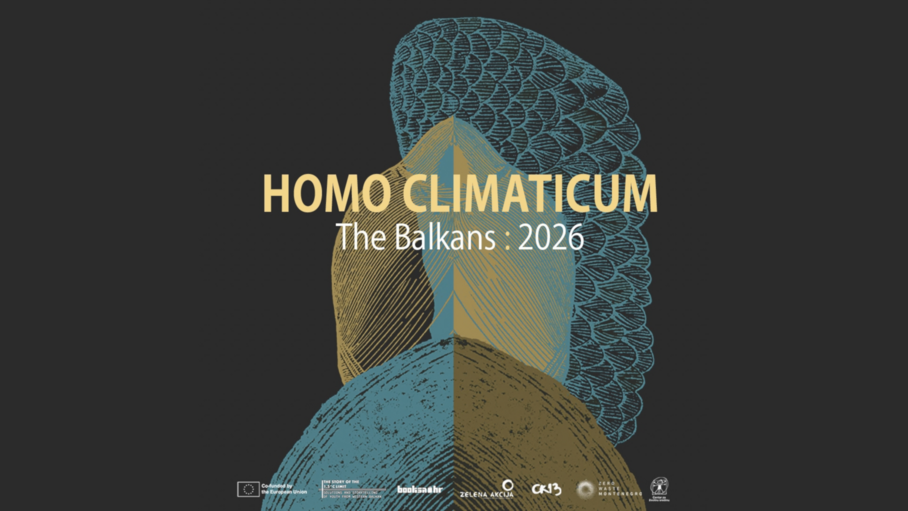
A regional collection of climate fiction stories and poems “Homo Climaticum: The Balkans: 2026” is now available in English!
What does the climate crisis look and feel like from the Western Balkans? Twelve stories from Croatia, Serbia, Bosnia and Herzegovina and Montenegro are now available to international readers in the English edition of Homo Climaticum: Balkan.
Climate change is often communicated through numbers: degrees of warming, tonnes of emissions, drought records, flooded areas and projections of what the coming decades might bring. But what happens when we tell the climate crisis through stories?
Homo Climaticum: Balkan brings together voices from a region already experiencing a changing climate, while carrying its own histories, inequalities, social tensions and ways of imagining the future.
Earlier this year, we published the regional edition of the collection following an open call for climate fiction. 130 short stories and poems were submitted from across the region, with authors spanning several generations. Twenty-eight works were selected for the regional collection, including 12 written by young people between the ages of 18 and 30. Now we are bringing some of these voices to a wider audience.
12 stories, four countries, one changing climate
The new English edition features three selected works from each of the four participating countries – Croatia, Serbia, Bosnia and Herzegovina and Montenegro.
Different in style, atmosphere and ideas of the future, the stories take us into overheated cities, transformed landscapes and societies dealing not only with environmental change, but also with questions of inequality, responsibility, belonging and our relationships with one another. These are stories rooted in particular places, but the questions they ask go far beyond the Balkans. What do we hold on to when the world around us changes? Who bears the consequences of a crisis they did least to create? What happens to our relationships, communities and imagination under pressure? And what kinds of futures are we still able to imagine?
This is where climate fiction can do something that statistics alone cannot: bring us inside the experience of change. As the regional edition demonstrated, the local and the global do not have to be opposing perspectives. A swimming pool in Istria, a post-apocalyptic Banja Luka or the heat of Mostar can tell stories about a planetary crisis precisely because they begin somewhere concrete.
Publishing the collection in English is also an invitation to bring perspectives from the Western Balkans into a broader international conversation about climate change. The region is often spoken about. With this collection, we want readers elsewhere in Europe and beyond to encounter stories told from within it, through the imagination, concerns, humour, fears and hopes of people living here.
Homo Climaticum: Balkan is therefore more than an exercise in imagining distant futures. Many of these stories begin with the feeling that climate change is not something waiting for us in the future, we are already living inside the change. And storytelling can help us make sense of that change.
Through the STORY project, we have been exploring storytelling and climate fiction not only as artistic forms, but also as tools for connecting people, developing empathy and opening conversations about the futures we want to create.
We invite readers, educators, youth workers, climate activists and everyone curious about climate fiction to discover these twelve voices from the Western Balkans.
Read them in classrooms and community spaces, discuss them with young people, share them across borders – or simply find a quiet place and allow yourself to enter the worlds they have created.
Download and read the English edition of Homo Climaticum: Balkan for free here:
https://zelena-akcija.hr/system/document/1415/doc_files/original/HC_ENG_2.pdf
---
Homo Climaticum: The Balkans 2026 was created through a regional climate-fiction competition organised by Zelena akcija/Friends of the Earth Croatia, Youth Center CK13, Center for Environment, Zero Waste Montenegro and Kulturtreger/Booksa.
The collection was developed within “THE STORY OF THE 1.5°C LIMIT – Solutions and storytelling of youth from Western Balkan”, a project funded by the European Union. The views and opinions expressed are those of the authors and do not necessarily reflect those of the European Union or the European Education and Culture Executive Agency (EACEA). Neither the European Union nor EACEA can be held responsible for them.